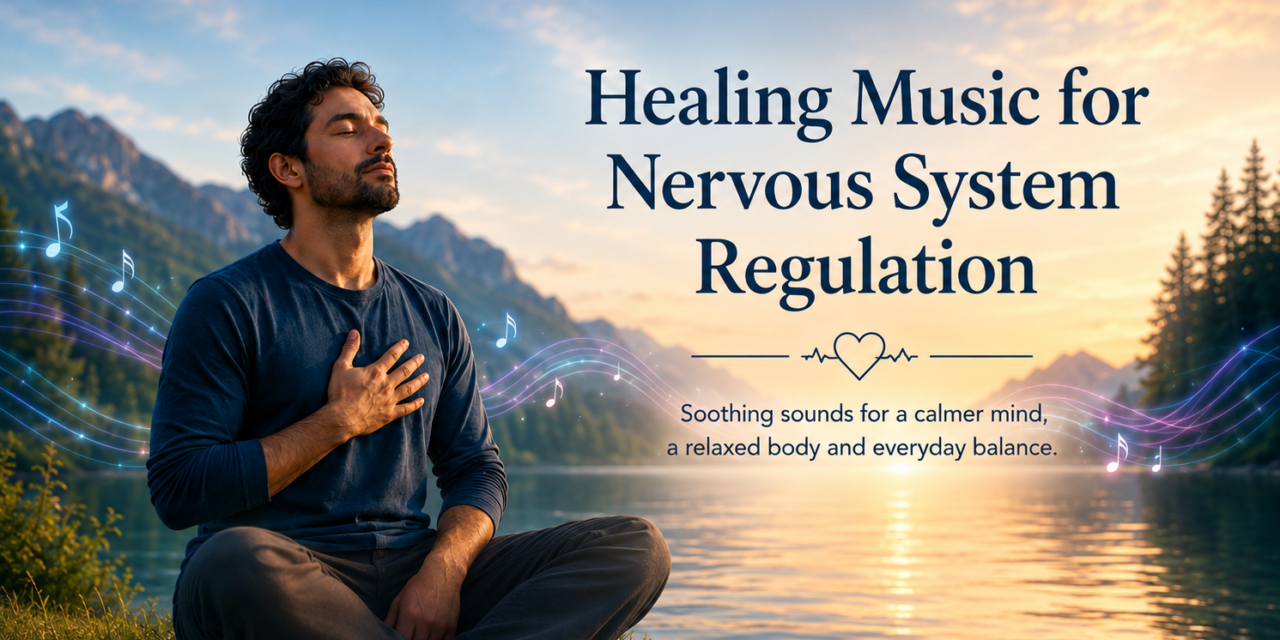
How Music Can Calm the Nervous System: The Power of Sound, Stress Relief and Relaxation
Music has an amazing ability to change the way we feel.
A familiar song can bring back a memory almost instantly. A gentle piano piece can soften the atmosphere in a room, while a slow, spacious soundscape can make it easier to step away from a busy mind for a few minutes.
The relationship between music and the nervous system has always fascinated me because music is not something we simply hear. We often feel it physically as well as emotionally. A rhythm can make us want to move, a sudden sound can put us on edge, and a calm piece of music can sometimes help the body begin to settle.
Researchers are increasingly interested in this connection too, particularly in the way music may influence stress, emotional arousal, heart activity and the autonomic nervous system.
If you are interested in the brain side of this subject, I explore that in more detail in The Healing Effects of Music on the Brain.
Here, though, I want to look at something slightly different: how music may help us move from a state of stress or overstimulation towards something calmer, and how we can use it in a simple way in everyday life.
Music and the Nervous System
Our nervous system is constantly responding to what is happening around us, often without us being consciously aware of it.
When we feel under pressure, the body can prepare us for action. Our heart may beat faster, breathing can become shallower and muscles may tighten. This response is useful when we genuinely need to react, but everyday life can sometimes leave us feeling switched on for longer than we would like.
Work, phones, constant information, poor sleep and persistent worrying can all make it harder to slow down properly.
One part of the nervous system involved in these automatic responses is the autonomic nervous system. This helps regulate processes such as heart activity, digestion and breathing.
You may have heard of the sympathetic and parasympathetic nervous systems. The sympathetic system is often associated with activity and the familiar fight-or-flight response, while the parasympathetic system is more closely linked with rest, digestion and recovery.
We need both. The aim is not to be relaxed all the time, but to be able to move more naturally between periods of activity and periods of rest.
This is where music becomes interesting.
How Music May Affect the Autonomic Nervous System
Music gives the brain and body a great deal to respond to: rhythm, melody, harmony, volume, repetition, expectation and emotional meaning.
A major review published in 2026 looked at 24 randomised controlled trials involving 1,295 participants and examined the effect of music on heart-rate variability, or HRV. HRV is one of the measures researchers use when studying autonomic activity.
The review found changes in some HRV measures following music interventions. Shorter sessions of 30 minutes or less, and music chosen by the participants themselves, produced particularly interesting results.
That does not mean a particular song can simply “switch on” the parasympathetic nervous system. Human responses to music are much more individual than that. But it does support the idea that listening to music can become part of the wider way our body responds to stress, rest and recovery.
If you would like to explore the broader relationship between sound, vibration and wellbeing, my guide to sound healing, music, frequency and vibration goes into that in more detail.
What Recent Research Says About Music and Stress Recovery
Another interesting study appeared in September 2026.
Researchers looked at what happened after people experienced acute stress and then listened either to music or to relaxing natural sounds.
The music group showed faster stabilisation in measures including heart activity and electrodermal activity, as well as an improvement in positive mood.
Brain imaging also suggested changes in communication between areas involved in hearing and regions connected with emotional and stress regulation.
What I find particularly interesting is that the structure of the music seemed to matter. Music constantly moves through tension and release, expectation and resolution. We do not just hear a sequence of sounds; we follow it emotionally.
That may help explain why the right piece of music can sometimes feel very different from simply sitting in a quiet room or listening to background noise.
The research is still developing, but it gives us another glimpse of something musicians and listeners have probably sensed for a long time: music can change the atmosphere inside us as well as around us.
Why Calming Music Can Feel So Powerful
Music can reach us in ways that are difficult to put into words.
A melody can remind us of somebody we love. A particular chord or sound may take us back to a place we have not thought about for years. Other music seems to create a sense of space without bringing up any obvious memory at all.
This is why I do not see healing music as something that simply plays quietly in the background.
When we really listen, music gives the mind somewhere to rest. Instead of following every thought that comes along, attention starts to settle on something outside the stream of thinking: the movement of a piano line, a sustained note, the resonance of a singing bowl or the quiet space between sounds.
That shift in attention alone can feel valuable.
What Is Heart-Rate Variability?
Heart-rate variability, usually shortened to HRV, describes the tiny variations in time between individual heartbeats.
Although we tend to imagine the heart beating at perfectly regular intervals, it actually varies from beat to beat. Those variations are influenced partly by the autonomic nervous system, which is why HRV is often used in research looking at stress and recovery.
The 2026 review mentioned earlier found significant changes in some HRV measures after music interventions, although not every measure or every study produced the same result.
That is worth remembering.
Research into music and the nervous system is promising, but it is not as simple as saying that one type of music will produce the same physical effect in everyone.
The interesting part is that listening to music is clearly not just a passive experience for the body.
Short Listening Sessions Can Still Be Valuable
One thing I like about using music for relaxation is that it does not have to become another complicated routine.
You do not necessarily need an hour of meditation or a perfectly quiet room.
Sometimes ten or fifteen minutes is enough to create a little space in the day. That might be after work, before bed, during a stressful afternoon or simply when you notice that your mind has become overloaded.
Research does not tell us that ten minutes is a magic number. But shorter music interventions have produced interesting results, and from a practical point of view a short routine is much easier to return to regularly.
A simple practice that you genuinely use is often more useful than an elaborate one that never quite happens.
Why Your Choice of Music Matters
Music is deeply personal, and I think this is one of the most important things to remember.
What feels peaceful to one person may do very little for somebody else. Some people find gentle piano relaxing, while others prefer nature sounds, chanting, ambient music, acoustic instruments or something familiar from their own musical past.
The 2026 HRV review is interesting here because participant-selected music performed better than standardised music for some of the outcomes examined.
That makes sense to me.
Our response to music can be shaped by taste, culture, memories, mood and what we happen to need at that particular moment.
There are days when I want a flowing piano melody. At other times I may prefer something much more spacious and atmospheric.
Healing music does not need to follow a strict formula. The most useful question may simply be: how does this music make me feel right now?
Can Music Help Reduce Stress?
The research around music and stress is encouraging, but I think this is an area where it is easy to make claims that go too far.
Different studies use different types of music, listening times, participants and measurements, so we should be cautious about statements such as “this song lowers cortisol” or “this frequency resets your nervous system”.
The reality is more complicated.
That does not make music any less useful.
Not every benefit has to show up as a dramatic biological change. Sometimes the value is simply that breathing feels a little easier, the shoulders relax, thoughts slow down or the day feels slightly less intense.
That kind of change still matters.
What About 432 Hz and 528 Hz?
There is a great deal of interest in so-called healing frequencies, particularly 432 Hz and 528 Hz.
I find this area fascinating, but I also think it is important to keep an open mind.
A randomised study published in 2026 compared instrumental music tuned to 432 Hz and 528 Hz with a no-music condition in 162 university students experiencing examination-related stress.
The researchers found differences in several biological markers after the listening sessions, although they did not find significant differences in the cognitive test used in the study.
That makes the subject worth exploring, but it is not enough to say that either frequency is a scientifically proven healing frequency.
There is much more happening within music than tuning alone. Tempo, harmony, melody, dynamics, repetition, instrumentation, texture and emotional connection can all influence the listening experience.
I prefer to think of frequency as one element within the wider world of sound healing, rather than the whole explanation for why music can feel healing.
You can read more about this in my guide to sound healing, frequency and vibration.
A Simple 10-Minute Music Practice for Relaxation
If you would like to try using music more intentionally, this is a simple place to start:
-
Choose somewhere comfortable. Sit or lie somewhere your body feels supported and allow your shoulders and jaw to relax.
-
Reduce distractions. Put your phone on silent if you can and lower overly bright lighting.
-
Notice your breathing. There is no need to force deep breaths. Just notice how you are breathing as the music begins.
-
Follow one part of the music. It might be a piano melody, a sustained note, a voice, a gentle texture or even the spaces between the sounds.
-
Notice how you feel afterwards. You do not need to experience anything dramatic. Perhaps you feel slightly calmer, your thoughts have slowed or you simply appreciated ten quiet minutes.
There is no right or wrong response.
The point is not to achieve a perfect meditative state. It is simply to create a little space.
Music, Meditation and the Nervous System
Music and meditation can work very naturally together.
For some people, sitting in complete silence makes thoughts seem even louder. Music gives attention something gentle to rest on.
A sustained tone can encourage stillness. A flowing piano melody can create emotional space. Nature sounds may help somebody feel more grounded.
Rather than trying to force the mind to become empty, we can allow sound to guide our attention somewhere calmer.
This is one reason I enjoy combining music with meditation.
If you would like to try this for yourself, you can listen to my 8-Minute Guided Meditation for Stress Relief, which combines spoken guidance with original calming music.
Sometimes wellbeing does not need to involve a dramatic change. A few minutes of slowing down and paying attention can be enough to alter the tone of the day.
Can Music Help Us Prepare for Sleep?
Bedtime is often when the body feels tired but the mind suddenly decides to become busy.
Music can help create a transition between the active part of the day and the quieter part of the evening.
A 2026 review of 14 randomised studies involving 1,730 older adults found improvements in reported sleep quality after music-based interventions.
The studies varied, so it would be wrong to suggest there is one type of music or one listening routine that works for everyone. Even so, the wider evidence suggests that music can be a useful part of a relaxing bedtime routine.
I do not think of sleep music as something that should force us to sleep. I see it more as part of the process of winding down.
Dim the lights, let the activity of the day begin to fall away and allow the music to mark the change of pace.
I created Soothing Sleep Music – Moonlight Ambience as a short relaxation experience combining calming piano, soft vocal sounds and peaceful night-time imagery.
Where Sound Healing Fits In
I think there is room for both science and the more spiritual experience of sound. They do not need to compete with each other.
Science can explore things we are able to measure, such as heart activity, brain activity, sleep, stress responses and emotional changes. Sound-healing traditions often explore more personal experiences such as grounding, emotional release, energy, intention and inner balance.
These are different ways of looking at our relationship with sound, and I find both fascinating.
A singing bowl may help somebody feel deeply centred. Chakra music may encourage reflection, while a piano melody can unexpectedly bring an emotion to the surface. These experiences can still have meaning even if we cannot reduce them to a single biological measurement.
For me, this is one of the areas where Music Energetics becomes particularly interesting. We can explore what science is beginning to tell us while remaining open to the emotional, creative, energetic and spiritual ways in which people experience music.
If you would like to explore this side of healing music further, visit my Complete Guide to Chakra Healing with Music.
Creating Your Own Music Ritual
You do not need to completely change your lifestyle to make music part of your wellbeing routine.
It can be as simple as choosing a particular point in the day when you stop for a few minutes and listen.
That might be after finishing work, before meditation, before bed or whenever you notice that your mind feels overloaded.
Over time, the habit itself can become familiar. The music begins to represent a point in the day when you stop doing and simply listen.
You can use meditation music, nature sounds, healing music or a favourite piece that makes you feel peaceful.
The important thing is not creating the perfect routine. It is finding something that genuinely helps you slow down.
Frequently Asked Questions About Music and the Nervous System
Can music calm the nervous system?
Music may support relaxation and influence processes connected with emotional arousal, attention, heart activity and the autonomic nervous system.
Recent research also suggests that music may support recovery after acute stress.
However, everybody responds differently, so I prefer to think of calming music as a supportive wellbeing tool rather than something that automatically produces the same response in everyone.
What type of music is best for nervous-system relaxation?
There is no single best type.
Many people enjoy slow instrumental music, gentle piano, ambient soundscapes, soft acoustic music or nature sounds. Personal preference is important, so music that feels pleasant and non-demanding to you is often a sensible place to start.
How long should I listen to calming music?
There is no perfect length of time.
Even five to fifteen minutes can create a useful pause during the day, while other people prefer longer sessions.
The most useful amount of time is one that feels comfortable and realistic enough to become part of your routine.
Is 432 Hz better for the nervous system?
Research into specific musical tuning frequencies is still developing.
Some studies have reported interesting biological or emotional differences following exposure to particular tunings, but current evidence does not establish 432 Hz as a universally superior or scientifically proven healing frequency.
The overall piece of music and the listener’s personal response are likely to matter as well.
Can I use music when I feel overstimulated?
Many people find quiet music helpful when they feel mentally overloaded.
If sound itself feels irritating or overwhelming at that moment, however, silence may be more appropriate.
The most important thing is to pay attention to your own response rather than feeling you have to listen to something simply because it is described as relaxing.
Final Thoughts
Music can be much more than entertainment.
It can give us somewhere to pause, reflect and reconnect with ourselves.
Research continues to reveal more about the relationship between music, stress recovery, heart-rate variability, sleep and the nervous system. There is still a great deal we do not fully understand, and I think that is part of what makes music so fascinating.
We can study frequencies, brain activity and biological responses, but there is also something much simpler and more human about hearing a piece of music and noticing that we feel different afterwards.
You do not need to find the perfect healing frequency or create a complicated meditation routine.
Sometimes a few quiet minutes are enough.
Choose music that feels right for you, give yourself time to really listen, and see where the sound takes you.
Research Referenced in This Article
Zhang E. et al. (2026). Effect of music intervention on heart rate variability: a systematic review and meta-analysis of randomized controlled trials. Frontiers in Psychology.
You S. et al. (2026). The structural dynamics of music drive acute stress recovery through functional reorganization of stress-regulation networks. Proceedings of the National Academy of Sciences.
Bozok D. et al. (2026). Acute Music-Frequency Exposure Modulates Salivary Stress and Neurotrophic Markers in Young Adults: A Randomized Controlled Trial. Brain and Behavior.
He Y. et al. (2026). Effects of music-based interventions on sleep quality in older adults: a systematic review and meta-analysis. Frontiers in Psychiatry.
This article is intended for general wellbeing and educational purposes and is not a substitute for professional medical or psychological advice.
Frequently Asked Questions About Music and the Nervous System
Can music calm the nervous system?
Music may support relaxation and influence processes connected with emotional arousal, attention, heart activity and the autonomic nervous system.
Recent research also suggests that music may support recovery after acute stress.
However, everybody responds differently, so I prefer to think of calming music as a supportive wellbeing tool rather than something that automatically produces the same nervous-system response in everyone.
What type of music is best for nervous-system relaxation?
There is no single best type of music for everyone.
Many people find slow instrumental music, gentle piano, ambient soundscapes, soft acoustic music or nature sounds calming.
Personal preference is important. Music that feels pleasant, familiar and non-demanding to you is often a good place to start.
How long should I listen to calming music?
There is no perfect length of time.
Even five to fifteen minutes can create a useful pause in the day, while some people prefer longer listening sessions.
The aim is not to reach a particular number of minutes, but to create a routine that feels comfortable and realistic.
Is 432 Hz better for the nervous system?
Research into specific musical tuning frequencies is still developing.
Some studies have reported differences in biological or emotional measures after listening to music tuned in particular ways, but current evidence does not establish 432 Hz as a universally superior or scientifically proven healing frequency.
The overall music and the listener’s personal response are also important.
Can I use music when I feel overstimulated?
Many people find quiet music helpful when they feel mentally overloaded.
However, if sound itself feels irritating or overwhelming at that moment, silence may be more appropriate.
Pay attention to your own response rather than feeling that you have to listen to music simply because it is described as relaxing.
What Helps You Relax?
Do you use music to help you unwind or feel calmer? I’d love to hear what works for you — whether it’s gentle piano, ambient music, nature sounds, chanting or something completely different.
Feel free to share your experience in the comments below.