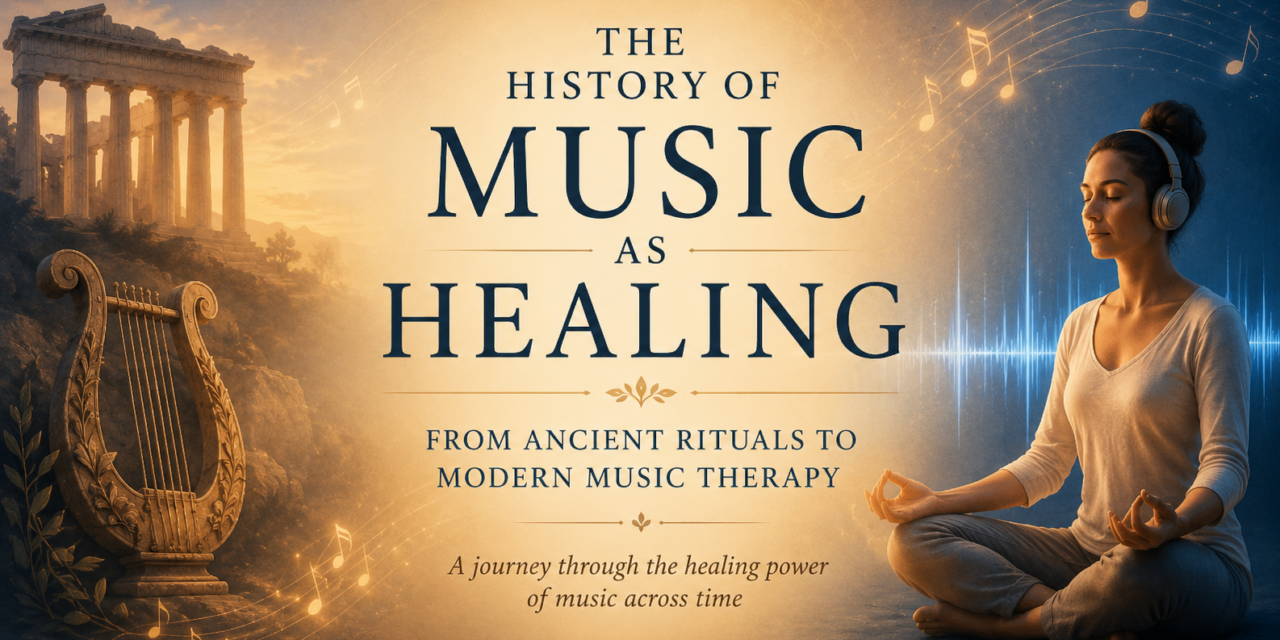
For as long as human beings have gathered together, music has been used for more than celebration, storytelling, or artistic expression. Across cultures and centuries, music has been used to soothe grief, mark spiritual transitions, calm the mind, support prayer, accompany healing rituals, regulate emotion, and bring people back into a sense of balance.
Long before modern science began studying the effects of rhythm, melody, vibration, and sound on the nervous system, ancient cultures already understood something deeply intuitive: music has the power to change how we feel.
Today, this ancient wisdom is being explored through modern music therapy, neuroscience, psychology, trauma recovery, meditation, and sound healing. The language has changed, but the core idea remains the same: sound can influence the body, the emotions, the mind, and the human spirit.
Music therapy as a formal profession developed strongly after the First and Second World Wars, when musicians played for injured and traumatised veterans in hospitals, and clinicians began observing measurable emotional and physical benefits. The American Music Therapy Association notes that the idea of music as a healing influence reaches back at least to the writings of Plato and Aristotle, while the modern profession grew significantly after musicians worked with veterans suffering from physical and emotional trauma.
If you would like to explore more of my healing music, meditation videos and sound-based articles, you can visit my main collection of healing music and meditation videos.
1. The Earliest Roots: Rhythm, Ritual, and the Healing Community
The earliest forms of healing music were not separated from community life. In many ancient cultures, music, rhythm, chanting, drumming, and dance were part of spiritual and communal healing practices.
Before written medicine, sound was often understood as a bridge between the visible and invisible worlds. Drums, rattles, flutes, voices, and repetitive rhythms were used to create altered states of awareness, support emotional release, and help individuals reconnect with the group.
In these early settings, music was rarely passive. It was participatory. People sang, moved, breathed, chanted, clapped, or listened together. Healing was not seen only as an individual matter; it was often communal, energetic, spiritual, and emotional.
This ancient use of music for healing reflects a truth still recognised today: music can help people feel held, connected, and less alone.
Rhythm has always played an important role in healing traditions. I explore this further in my article and video on the health benefits of drumming for the body and mind.
2. Music in Ancient Greece: Harmony, the Soul, and Medicine
Ancient Greece played a major role in shaping Western ideas about music and healing. Greek philosophers and physicians believed that music could influence the soul, emotions, character, and physical wellbeing.
Pythagoras is often associated with the idea that music and numbers were connected through harmony, proportion, and order. To the ancient Greeks, harmony was not only a musical concept; it reflected the balance of the cosmos, the body, and the soul.
Plato and Aristotle also wrote about the moral and emotional effects of music. They believed that different musical modes could influence mood, behaviour, and inner character. Music was not treated as a neutral background experience. It was understood as something capable of shaping human consciousness.
Ancient Greek healing temples, known as Asclepieia, combined spiritual practice, rest, ritual, dream incubation, bathing, exercise, and the arts. A modern review of Asclepieia notes that poetic and musical performances, including hymns and paeans, were present in sanctuaries of Asclepios, and that ancient Greeks recognised music’s therapeutic value.
This Greek view is especially important because it connects music with order, harmony, purification, and emotional balance — ideas that continue to influence modern sound healing and therapeutic music.
3. Music, Chant, and Sacred Healing Traditions
Throughout history, sacred music has been central to healing. Chanting, prayer, devotional singing, mantras, hymns, and sacred tones have been used in spiritual traditions around the world.
In many traditions, the human voice was considered especially powerful because it came directly from the body. Breath, tone, vibration, and intention were united through singing or chanting.
Examples include:
- Gregorian chant in Christian monastic traditions
- Vedic chanting and mantra in Indian spiritual practice
- Sufi music and devotional singing
- Buddhist chanting and temple bells
- Indigenous drumming and ceremonial song
- Hebrew psalms and sacred song
- African healing rhythms and call-and-response singing
These practices were not simply musical performances. They were ways of entering a different state of awareness. Repetition, rhythm, and tone helped quiet the thinking mind and create a sense of connection with something larger than the self.
This is one reason why music remains so powerful in meditation today. Repetitive sound can help the nervous system settle, the breath slow down, and the mind move away from anxious thought patterns.
4. Music in Ancient and Medieval Medicine
In ancient and medieval healing systems, music was often connected to the idea of balance.
Before the rise of modern medicine, many cultures believed illness could come from disharmony — within the body, between the emotions, or between the person and the spiritual world. Music was one way of restoring harmony.
Historical research has shown that music was used for healing purposes across antiquity and the Middle Ages, including in ancient Greek medicine, Byzantine healing institutions, and Islamic medical settings. A Yale dissertation on musical therapy from Asklepieia to bīmāristāns explores how music’s healing role continued through Greek, Byzantine, and Islamic medical traditions.
In Islamic medicine, hospitals known as bīmāristāns sometimes used music as part of care. The use of music in these settings reminds us that healing music was not only spiritual or ceremonial; in some cultures, it was also part of organised medical environments.
This long history shows that the relationship between music and healing did not suddenly appear in modern times. It has deep roots across different civilisations.
5. The Renaissance and the Idea of Musical Balance
During the Renaissance, music continued to be linked with mathematics, astronomy, spirituality, and the human body. The ancient idea of the “music of the spheres” suggested that the universe itself was ordered through harmonic principles.
Although this idea may sound poetic today, it reflects a recurring belief: that music mirrors patterns of balance found in nature.
Renaissance thinkers often saw music as a way of refining the emotions and elevating the soul. Music was used in religious devotion, education, courtly life, and private contemplation.
At this point in history, music was still not viewed purely as entertainment. It was considered capable of influencing temperament, morality, emotion, and spiritual awareness.
6. The 18th and 19th Centuries: Music, Emotion, and the Nervous System
As medicine and science developed, music gradually began to be discussed in more clinical terms.
By the 18th and 19th centuries, doctors and researchers were increasingly interested in the relationship between music, the nervous system, mood, and mental health. Music was sometimes used in hospitals and asylums to calm patients, lift mood, or encourage movement.
During this period, music became associated with emotional expression. Composers such as Beethoven, Schubert, Chopin, and later the Romantics showed how deeply music could express grief, longing, hope, conflict, and transcendence.
This emotional depth helped shape the modern understanding of music as a way of processing feeling. Even today, people often turn to music when words are not enough.
Music can give shape to emotions that feel too complex, painful, or subtle to explain.
7. War, Trauma, and the Birth of Modern Music Therapy
The modern profession of music therapy grew significantly during and after the World Wars.
During the First and Second World Wars, musicians visited hospitals to play for soldiers recovering from physical injuries, emotional trauma, and psychological distress. Doctors and nurses began to notice that music could support mood, pain management, movement, social connection, and emotional expression.
The American Music Therapy Association explains that the 20th-century profession formally began after World War I and World War II, when musicians played for veterans suffering from physical and emotional trauma. The positive responses led hospitals to request training standards, and the first music therapy college curriculum was founded at Michigan State University in 1944.
This period was crucial because music therapy began moving from informal practice into structured professional training. Music was no longer only seen as comforting; it was increasingly recognised as a therapeutic tool that required skill, sensitivity, and clinical understanding.
8. The Development of Music Therapy in the UK
In the UK, music therapy became more formally organised in the 20th century.
The British Association for Music Therapy notes that although music had been acknowledged as a means of healing for thousands of years, music therapy was scarcely known as a profession in the UK before early pioneers began developing the field.
Juliette Alvin was one of the most important figures in British music therapy. She helped establish music therapy as a recognised discipline and contributed to its growth in education, healthcare, and therapeutic settings.
According to Sing Up Foundation, music therapy as a profession in the UK first became organised in 1958, when Juliette Alvin established the Society for Music Therapy and Remedial Music. In 1967, this became the British Society for Music Therapy.
Today, music therapists work in hospitals, schools, mental health services, hospices, dementia care, disability support, trauma recovery, and community settings.
9. Music and the Brain: A Modern Scientific Understanding
Modern neuroscience has helped explain why music can have such a powerful effect on human beings.
Music activates many areas of the brain at once. It can involve memory, emotion, movement, attention, language, reward, and sensory processing. This is one reason music can reach people in ways ordinary speech sometimes cannot.
Music can affect:
- Heart rate
- Breathing patterns
- Stress response
- Emotional regulation
- Memory recall
- Movement and coordination
- Pain perception
- Social bonding
- Mood and motivation
Research reviews have explored music therapy’s effects across a wide range of areas, including mental health, depression, pain, dementia, and neurological conditions. One systematic review summary found evidence that listening to music may help reduce depressive symptoms in adults, although outcomes vary depending on the condition, method, and quality of studies.
This does not mean music is a cure-all. But it does show that music can be a meaningful support for wellbeing when used appropriately.
For a deeper explanation of how sound and music interact with the mind, you may also enjoy reading my article on how music affects the brain.
10. Music, Emotion, and Memory
One of music’s most powerful healing qualities is its relationship with memory.
A song can bring back a person, a place, a period of life, or an emotion within seconds. This is why music is often used in dementia care, grief work, reminiscence therapy, and emotional healing.
Music can bypass purely logical thinking and touch emotional memory directly. Sometimes, a melody helps people access feelings they have buried or forgotten. At other times, music provides comfort without requiring explanation.
This is especially important for people experiencing grief, anxiety, trauma, or emotional numbness. Music can gently open a doorway to feeling, without forcing the mind to analyse everything.
In this sense, healing music does not always “fix” an emotion. Sometimes it simply gives the emotion space to move.
11. Rhythm, the Body, and Regulation
Rhythm is one of the oldest healing elements of music.
The body itself is rhythmic. The heartbeat, breath, walking pace, sleep cycles, brainwaves, and nervous system all operate through patterns of rhythm.
This may explain why rhythm can feel so grounding. A steady beat can help organise movement, focus attention, and create a sense of safety. Slow rhythms can encourage relaxation, while stronger rhythms can energise the body and support motivation.
In modern therapy and rehabilitation, rhythm is used in movement work, neurological rehabilitation, Parkinson’s support, stroke recovery, and trauma-informed practices.
On a simpler everyday level, people instinctively use rhythm to regulate themselves. We hum, tap, rock, sing, breathe in patterns, or walk to music because the body responds naturally to pulse and repetition.
12. Sound Healing, Meditation Music, and Energy Practices
Alongside clinical music therapy, there has also been a renewed interest in sound healing, meditation music, chakra music, frequency-based compositions, singing bowls, gongs, drones, overtone instruments, and ambient healing music.
These practices often focus less on clinical treatment and more on relaxation, spiritual connection, energetic balance, emotional release, and meditative states.
Sound healing traditions may use:
- Singing bowls
- Gongs
- Tuning forks
- Voice toning
- Drums
- Chimes
- Drone instruments
- Ambient textures
- Binaural beats
- Solfeggio-inspired frequencies
- Chakra-based musical themes
While some claims about specific frequencies require careful language, many people experience healing music as deeply calming, emotionally supportive, and spiritually meaningful.
If you are interested in energy cleansing through sound and meditation, you may also like my cleansing meditation music video.
Healing music is not a substitute for professional medical or psychological care, but it can be a powerful companion for relaxation, meditation, emotional processing, and inner balance.
13. Music as Emotional Release
Across history, one of music’s most important healing roles has been emotional release.
In ancient ritual, sacred chant, folk song, lament, blues, gospel, classical music, and modern meditation music, people have used sound to express what cannot be spoken.
Music can help release:
- Grief
- Sadness
- Fear
- Anger
- Longing
- Anxiety
- Spiritual disconnection
- Emotional tension
- Inner heaviness
This is because music allows emotion to move through the body. A person may cry, breathe more deeply, soften physically, remember something important, or feel a sense of peace after listening.
From a healing perspective, this matters. Emotions often become painful when they are suppressed, blocked, or held in the body for too long. Music can provide a safe container where feeling is allowed to arise and pass.
For a practical example of music created to support emotional release, you can also read my article on healing music for emotional release.
14. Why Music Still Heals Today
Although the world has changed dramatically, the healing power of music remains relevant because human beings still experience stress, grief, trauma, anxiety, isolation, and emotional overwhelm.
Modern life often disconnects people from silence, rest, breath, and inner awareness. Healing music can help restore these connections.
Music can support healing by helping us:
- Slow down
- Breathe more naturally
- Feel emotions safely
- Reconnect with the body
- Enter a meditative state
- Release mental tension
- Feel comforted
- Access memories
- Experience beauty
- Feel spiritually connected
This is why music continues to appear in hospitals, therapy rooms, meditation spaces, yoga classes, spiritual ceremonies, homes, and personal healing practices.
The form may change, but the need remains the same.
For a short calming practice, try my 5-minute meditation music video, created to help bring the mind back into balance and stillness.
15. From Ancient Temples to Modern Playlists
The history of healing music shows a remarkable continuity.
Ancient healers used drums, chants, flutes, lyres, hymns, and sacred songs. Modern practitioners use piano, ambient soundscapes, therapeutic songwriting, guided meditation, carefully selected playlists, clinical music therapy, and sound healing instruments.
The tools have evolved, but the intention is familiar: to restore harmony.
Where ancient cultures spoke of the soul, modern science may speak of the nervous system. Where spiritual traditions spoke of energy, modern psychology may speak of emotional regulation. Where healers once used ritual song, modern therapists may use structured musical intervention.
These languages are different, but they often point toward the same human experience: music can help us return to balance.
The Timeline of Music and Healing
Ancient and Prehistoric Traditions
Music, rhythm, chanting, and dance are used in ritual, ceremony, and communal healing.
Ancient Greece
Philosophers and physicians explore the relationship between music, harmony, emotion, and the soul. Music is used in healing sanctuaries and spiritual practice.
Sacred and Religious Traditions
Chant, mantra, hymns, bells, drums, and devotional singing are used for prayer, meditation, emotional release, and spiritual healing.
Medieval and Islamic Medicine
Music is used in some medical and healing environments, including historical hospital settings and spiritual care.
Renaissance Thought
Music is linked with harmony, mathematics, cosmology, and emotional refinement.
18th and 19th Centuries
Doctors and thinkers become increasingly interested in music’s effects on the nervous system, mood, and mental health.
World War I and World War II
Musicians play for injured and traumatised soldiers. Hospitals observe therapeutic benefits, helping shape the modern profession of music therapy.
Mid-20th Century
Formal music therapy training and professional organisations begin developing in the United States and the UK.
Late 20th and 21st Centuries
Music therapy, neuroscience, sound healing, meditation music, and wellness practices continue to explore how music supports emotional, physical, and spiritual wellbeing.
Frequently Asked Questions
Has music always been used for healing?
Yes. Music has been used for healing, ritual, emotional expression, and spiritual connection for thousands of years. Ancient cultures used rhythm, chant, melody, and sacred sound to support wellbeing long before modern music therapy existed.
What is the difference between music therapy and healing music?
Music therapy is a professional clinical practice delivered by trained music therapists. Healing music is broader and may include meditation music, sound healing, relaxation music, spiritual music, or personal listening practices used to support wellbeing.
Did ancient Greeks use music for healing?
Yes. Ancient Greek thinkers connected music with harmony, emotion, and the soul. Music was also present in healing sanctuaries connected with Asclepios, where ritual, rest, prayer, and the arts formed part of the healing environment.
When did modern music therapy begin?
Modern music therapy developed strongly after World War I and World War II, when musicians played for veterans in hospitals and clinicians observed benefits for emotional and physical recovery.
Can music help with stress and anxiety?
Music may help many people relax, slow their breathing, regulate mood, and reduce stress. However, it should be seen as a supportive wellbeing tool rather than a replacement for medical or psychological treatment.
If you are experiencing stress or anxious thoughts, you may also find support in this guided meditation for stress and anxiety relief.
Why does music affect emotions so strongly?
Music activates brain areas involved in emotion, memory, attention, movement, and reward. It can also influence breathing, rhythm, and bodily tension, which is why it can feel emotionally powerful and physically calming.
Is sound healing scientifically proven?
Some areas of music-based intervention, especially clinical music therapy, have a growing evidence base. Sound healing and frequency-based practices are more varied, and some claims require careful interpretation. Many people still find these practices helpful for relaxation, meditation, and emotional release.
Conclusion: Music as a Path Back to Harmony
The history of music as healing is not a passing trend. It is one of humanity’s oldest forms of care.
From ancient temples to hospital wards, from sacred chant to modern meditation music, from communal drumming to personal playlists, music has always helped people move through pain, emotion, change, and transformation.
Music reaches places that words often cannot. It can soften the body, calm the mind, stir memory, open emotion, and reconnect us with something deeper within ourselves.
In this way, healing music is not only about sound. It is about relationship — the relationship between vibration and body, rhythm and breath, melody and emotion, silence and spirit.
Across history, music has reminded us that healing is not always about force or effort. Sometimes, healing begins when we listen.
Has music ever helped you through a difficult time?
Throughout history, people have turned to music for comfort, healing, prayer, emotional release, and inner peace. I’d love to hear your own experience. Has a particular song, sound, instrument, meditation, or piece of healing music helped you feel calmer, more connected, or supported during a challenging moment?
Please feel welcome to share your thoughts in the comments below.
Explore More Healing Music Articles
If this article has inspired you to explore the healing power of music more deeply, you may also enjoy these related Music Energetics articles and meditation videos: