
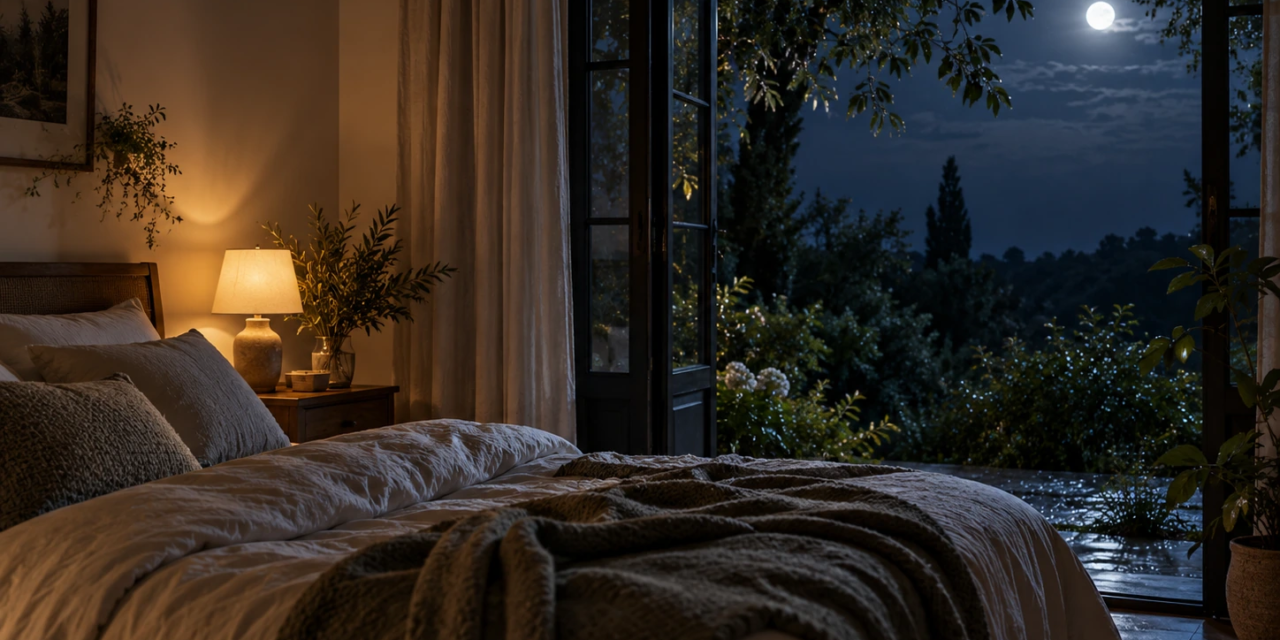
There is something about the sound of nature that can change the atmosphere almost immediately.
Gentle rain against a window, waves moving onto a beach, birds in the distance or water flowing through a stream can all create a feeling of space that is very different from the constant background noise of everyday life.
I have always found this interesting because these sounds are not music in the traditional sense. There may be no melody, harmony or rhythm in the way we normally think about them, yet they can still affect how we feel.
For some people, nature sounds for sleep become part of a regular evening routine. Others use them while meditating, reading or simply trying to unwind after a busy day.
Recent research is also giving us a better understanding of how the wider soundscape around us may influence relaxation, stress recovery and sleep.
Rather than looking for one perfect sound, I think it is more useful to ask a simpler question:
What kind of sound environment helps us feel able to slow down?
What Is a Soundscape?
A soundscape is essentially the complete sound environment around us.
At home, that might include traffic outside, a television in another room, birds in the garden, rain, voices, appliances or music.
When we walk through a forest, the soundscape might include wind moving through trees, water, birds, insects and the occasional movement of branches or leaves.
We often pay much more attention to what we can see than to what we can hear, but sound is constantly shaping our experience of a place.
A room can look peaceful and still feel difficult to relax in if there is unpredictable traffic noise outside. In the same way, an ordinary outdoor space may feel completely different when birdsong or flowing water becomes part of the experience.
This is one of the things I find fascinating about sound. We do not always consciously listen to everything around us, but that does not mean our minds and bodies completely ignore it.
If you are interested in the wider relationship between sound and wellbeing, my guide to sound healing, music, frequency and vibration explores this in more detail.
Why Do Nature Sounds Feel So Calming?
There is probably no single answer.
Some natural sounds are gentle and fairly predictable. Rain may continue with a soft, steady texture. Ocean waves rise and fall gradually. A stream creates continuous sound without demanding our attention.
These qualities can be very different from the sudden alarms, engines, phones and mechanical noises that fill modern life.
Natural sounds can also be associated with places we already experience as peaceful. The sound of waves may remind us of a holiday or a quiet walk along the coast. Birds may bring to mind a garden or a morning spent outdoors.
Our response is therefore likely to involve both the characteristics of the sound itself and the meaning we attach to it.
What relaxes one person will not necessarily relax another.
I personally think this is important whenever we talk about healing sound. We can explore what research tells us while still remembering that listening remains a very individual experience.
New Research Into Natural Soundscapes and Recovery
A particularly interesting study was published in October 2026.
Researchers looked at working adults taking a 30-minute break in a rooftop garden exposed to significant urban traffic noise.
For one group, the environment was subtly enhanced with natural sounds, including bird calls. The other group experienced the same space without the added soundscape.
The researchers monitored heart-rate variability before and after the visit and continued monitoring participants into the night.
The group exposed to the natural soundscape showed higher heart-rate variability after the break, suggesting a physiological response associated with recovery. Interestingly, part of this effect could still be detected during the early stages of sleep that night.
The effect did not continue into the following morning, so this was not evidence of a permanent change.
I think that makes the study more interesting rather than less.
It suggests that creating a more pleasant sound environment may help support a period of recovery without needing to claim that a few minutes of birdsong somehow transforms the nervous system.
Sometimes a temporary change is exactly what we need.
Nature Sounds and Wellbeing
Another large piece of research published in October 2026 looked more broadly at soundscapes and wellbeing.
Researchers reviewed 194 studies and carried out a meta-analysis using data from 66 of them.
Natural sounds showed the most consistent positive associations across areas including environmental experience and health-related outcomes.
Again, this does not mean that listening to birds or water is a treatment for stress or illness.
What it does suggest is that our sound environment deserves more attention.
We often think about wellbeing in terms of diet, exercise, sleep and perhaps meditation. But the places we spend time in also have a sound.
Some of those sounds are tiring.
Others may help create conditions in which slowing down becomes easier.
Can Nature Sounds Help with Sleep?
This is where the subject becomes especially interesting.
Sleep is not something we can force.
The more we worry about falling asleep, the more difficult it can sometimes become.
For that reason, I prefer to think of nature sounds as part of a wind-down environment rather than as something that makes us sleep.
A recent 2026 systematic review looked at sound-based interventions designed to improve sleep in hospital patients.
Overall, the researchers found that sound-based approaches improved reported sleep quality, although the results varied according to the type of sound, setting and way the intervention was delivered.
Hospital sleep is obviously very different from sleeping at home, so we should not assume the findings apply in exactly the same way to everybody.
However, the research adds to a wider idea that the sound environment around us can influence how easy or difficult rest feels.
At bedtime, that might mean reducing disruptive noise, creating a more predictable environment or introducing gentle sounds that we personally associate with calm.
If you enjoy music as part of your evening routine, you may also like my Soothing Sleep Music – Moonlight Ambience, which combines calming piano with a peaceful night-time atmosphere.
Which Nature Sounds Are Best for Relaxation?
There is no perfect sound for everyone.
This is where personal preference matters.
Rain
Rain is popular because it creates a fairly continuous sound without much variation.
For some people, that consistency can help mask distracting background noise.
There is also something comforting about hearing rain while being warm and sheltered indoors.
Ocean Waves
Waves naturally rise and fall, creating a slow sense of movement.
Some listeners enjoy this rhythm because it feels spacious rather than repetitive.
A quiet shoreline can work particularly well for evening relaxation, although louder crashing waves may be too stimulating for some people.
Flowing Water
Streams and gentle waterfalls create a more detailed sound than rain.
There is constant movement, but it tends to remain soft and continuous.
I particularly like the combination of flowing water with gentle instrumental music because the natural sound can sit underneath the music rather than compete with it.
Birdsong
Birdsong is a little different because it contains more variation and individual sound events.
During the daytime, it can create a strong feeling of being outdoors and connected with nature.
At night, however, some people may find birdsong less natural simply because it does not match the time of day.
Wind Through Trees
The soft movement of leaves and branches can create an almost musical texture.
It has less obvious rhythm than waves or rain, which may appeal to people who prefer something very subtle.
The best sound is the one that makes your own environment feel calmer rather than the one somebody else says is scientifically perfect.
Nature Sounds, White Noise and Pink Noise
Nature sounds are sometimes grouped together with white noise and pink noise, but they are not really the same thing.
White noise contains energy spread across a broad range of frequencies and creates the familiar steady “hissing” sound.
Pink noise distributes that energy differently, giving it a deeper and often softer character.
Nature sounds are much more complex. Rain, wind and water constantly change, even when the overall sound feels steady.
Some people prefer artificial noise because it is predictable and effective at masking background sounds.
Others find natural sound more pleasant because it feels less mechanical.
There is no need to choose one approach for life.
You might prefer rain while working, gentle music during meditation and pink noise when travelling.
What matters is how the sound fits the situation.
Can Nature Sounds and Music Work Together?
I think this is where the subject becomes especially relevant to Music Energetics.
Nature sounds and music do not have to be separate experiences.
A gentle piano piece can sit beautifully over the sound of rain or flowing water. Ambient pads can blend into waves. Soft sustained tones can add warmth without taking attention away from the natural environment.
The balance matters.
If too much music is added, the nature sound can simply become another background effect.
If the music is spacious enough, the two can work together.
As a musician, I like the idea of allowing nature to become part of the composition rather than simply placing it underneath afterwards.
A pause in the piano can leave space for a wave.
A sustained chord can gradually disappear into the sound of rain.
A stream can provide movement without needing a conventional rhythm.
This creates a different kind of listening experience — somewhere between music, ambience and meditation.
You can explore more of my original relaxation and meditation music in the Healing Music Videos collection.
A Simple 10-Minute Nature Sound Practice
You do not need to turn this into a complicated meditation.
Choose one natural sound that you genuinely enjoy. It might be rain, waves, a forest, a stream or a recording made in a garden.
Then give yourself ten minutes without trying to achieve anything.
Sit somewhere comfortable and allow the sound to play at a gentle level. You can close your eyes if that feels natural, but there is no need to.
For the first minute or two, simply notice the sound.
You may start hearing details you had not noticed at first: individual drops of water, movement in the wind, distant birds or the changing texture of waves.
If your thoughts wander, let them.
There is no need to force concentration. Just bring your attention back to the sound when you remember.
At the end, notice whether anything has changed.
You may feel calmer. You may simply feel that ten minutes passed pleasantly.
Both are worthwhile.
Creating a Calmer Sound Environment at Home
We often focus on adding relaxing sounds, but sometimes the first step is removing unnecessary ones.
Television playing in the background, phone notifications, appliances, traffic and several conversations happening at once can create a surprisingly busy sound environment.
You do not need complete silence.
It may simply help to become more aware of what you are hearing.
Try sitting in your usual evening space for a minute and noticing the sounds around you.
Which ones feel neutral?
Which feel pleasant?
Which ones make the environment feel busier?
Once you notice them, small changes can make a difference.
You might close a window facing a busy road and open one facing the garden instead. Turn off a television nobody is really watching. Reduce notification sounds. Play gentle rain or music quietly rather than having several competing sources of noise.
The aim is not to create a perfectly silent home.
It is to make the sound environment feel a little more intentional.
Nature Sounds and Meditation
Natural sounds can also work very well with meditation.
For anyone who finds silence uncomfortable, a soundscape gives the mind something gentle to return to.
Water can create a feeling of movement.
Rain can make the outside world seem slightly more distant.
Birdsong can bring attention back towards the present moment.
This works in a slightly different way from following a guided voice or a melody. The sound is there, but it does not demand very much from us.
That can make nature sounds useful when you simply want to sit quietly rather than follow a structured meditation.
For a more guided approach, you might prefer my 8-Minute Guided Meditation for Stress Relief, which combines spoken guidance with original calming music.
Do Nature Sounds Need to Be Real?
This is an interesting question.
There is obviously something special about hearing a stream while actually sitting beside one.
The temperature, light, smell, movement and surroundings all become part of the experience.
A recording cannot reproduce all of that.
But recorded sound can still change the atmosphere of a room.
A good recording of rain may help mask traffic. Ocean sounds may remind somebody of a place they find peaceful. A forest soundscape can create a sense of space when somebody is living in the middle of a city.
I do not think we need to pretend that a recording is equivalent to being in nature.
It is simply another way of bringing part of that experience into everyday life.
Frequently Asked Questions About Nature Sounds for Sleep
Are nature sounds good for sleep?
Some research suggests that sound-based interventions can support reported sleep quality, and recent studies have found interesting links between natural soundscapes, physiological recovery and the early stages of sleep.
However, responses vary from person to person.
Nature sounds are best thought of as part of a relaxing sleep environment rather than a guaranteed way to make yourself fall asleep.
What is the best nature sound for sleeping?
There is no single best sound.
Many people enjoy gentle rain, waves or flowing water because they are relatively continuous and predictable.
Choose something you find pleasant and that does not contain sudden changes that wake or distract you.
Is rain better than white noise for sleep?
Neither is automatically better.
White or pink noise may be useful for masking inconsistent environmental noise, while rain may feel more natural and emotionally pleasant.
Your own response is the most useful guide.
Should nature sounds play all night?
They do not have to.
Some people prefer to use sound only while winding down, while others leave it playing quietly throughout the night.
If you use headphones, I would avoid sleeping in them unless they are specifically designed for safe and comfortable overnight use.
Can I combine nature sounds with relaxing music?
Yes.
Gentle music and natural soundscapes can work very well together.
The key is to keep the arrangement spacious enough that the two elements complement rather than compete with each other.
Final Thoughts
Our sound environment is easy to overlook.
We notice bright lights, clutter and uncomfortable furniture, but we may spend much less time thinking about what our surroundings sound like.
Yet sound is always there.
Sometimes it demands our attention. Sometimes it sits quietly in the background.
And sometimes the right sound can change the feeling of a place completely.
Recent research into natural soundscapes is giving us a better understanding of how sound may contribute to relaxation, recovery and sleep. There is still much to learn, and I would be cautious about turning that research into claims that a particular sound can cure stress or guarantee better sleep.
For me, the value is simpler.
Rain can make an evening feel cosy.
A stream can help the mind slow down.
Waves can bring back a sense of space.
Birdsong can make us feel a little closer to the natural world.
And when we combine those sounds thoughtfully with music, we have another beautiful way to create a few moments of calm.
Sometimes that is enough.
Join the Conversation
Are there particular sounds from nature that help you relax?
Perhaps you enjoy rain at night, waves by the sea, birds in the morning or the sound of flowing water.
I would love to hear which natural sounds you find most calming and whether you prefer listening to them on their own or combined with music.
Feel free to share your experience in the comments below.
Wellbeing note: This article is intended for general educational and wellbeing purposes and is not a substitute for professional medical or psychological advice.
Research and Further Reading
If you would like to explore the research behind this article in more detail, these sources are useful starting points:
-
Natural soundscaping and sleep recovery in a noisy urban environment – a 2026 study examining how added natural sounds influenced physiological recovery and early sleep.
-
Soundscapes and wellbeing: systematic review and meta-analysis – a large 2026 review examining the relationship between different sound environments and wellbeing outcomes.
-
Sound-based interventions for sleep in hospitalised adults – a 2026 systematic review looking at how different forms of sound may support sleep quality.
-
World Health Organization guidance on safe listening – practical guidance on safe headphone and audio listening.