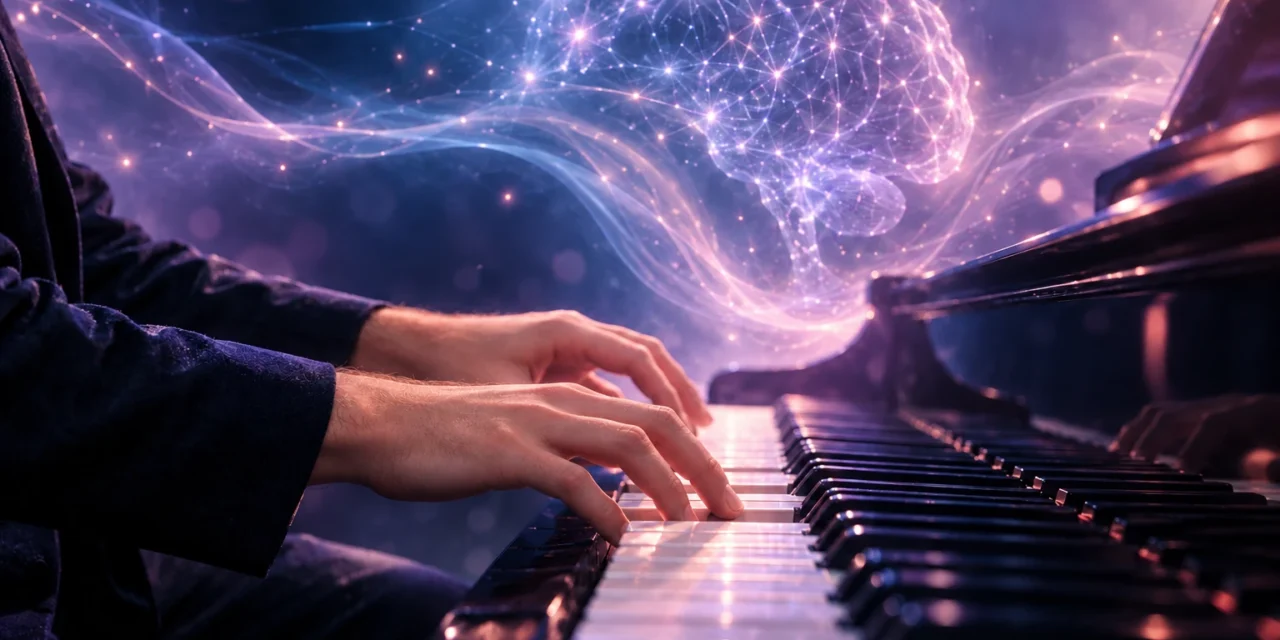
I have always been interested in how playing the piano can express feelings that are difficult to put into words. A simple melody can take on a different character through a softer touch, a change of pace or a pause before the next note.
This connection between piano music and emotion is something I explore through my own music. So I was interested to come across research looking at brain activity during an expressive piano performance.
What happens as a musician gives a piece its feeling? And how much of our response comes from the way the notes are played?
The research offers a glimpse into these questions. It also gives us a reason to listen more closely to the small details that make a performance feel personal.
How piano playing expresses emotion
Think about how much you can hear in someone’s voice. The words tell you something, but their pace, emphasis and tone add to the meaning. Even a brief pause can change how you understand a sentence.
A pianist has similar choices. A melody can be played with a steady, firm rhythm, or given more space, with certain notes allowed to linger. The written music may be the same, yet the performance can feel quite different.
Musicians describe changes in volume as dynamics. They use phrasing to describe how a group of notes is shaped into a musical thought. There is also rubato, where the timing is gently stretched and relaxed for expression.
You do not need to recognise these techniques by name to appreciate them. You might notice that a passage feels hesitant, that a melody becomes more insistent, or that the final notes seem to settle.
Sometimes the detail that catches your attention is quite small: a quiet note where you were expecting something stronger, or a moment of space before a familiar melody returns.
Looking at the brain during a piano performance
In an October 2026 study published in Frontiers in Cognition, Alice Mado Proverbio and Giulia Carta recorded electrical brain activity from one professional pianist performing Bach, Beethoven and Chopin.
Using a 128-channel EEG cap, they examined short passages grouped by listeners’ descriptions, including joy, peacefulness, melancholy and tension.
Their analysis suggested a shared network supporting skilled movement, with variations across expressive categories. Passages described as joyful showed higher estimated activity in deep brain structures than melancholic passages. Some measures also varied with movement rate and note density.
There are limits to what this tells us. The descriptions came from listeners, rather than direct reports of the pianist’s feelings. Musical features and physical demands differed between passages, making emotion difficult to separate from movement. Estimates of activity in deeper brain structures also carry uncertainty.
This was an exploratory study of one expert. It offers clues about that performance, rather than a general map of musical emotions.
How listeners respond to expressive piano music
There is another side to this: the experience of the person listening.
An earlier study by Heather Chapin and colleagues compared responses to two versions of the same Chopin piece. One contained the natural changes in timing and volume of an expressive performance. The other maintained a constant tempo and intensity.
The researchers found that expressive features were associated with activity in brain systems involved in emotion, reward and movement. Musical experience also influenced listeners’ responses. The findings support the idea that the performance contributes to our experience of music, alongside the composition itself.
This gives us something quite practical to listen for. When a passage catches your attention, notice how it is played. Perhaps the pianist slows slightly before the melody returns, or brings one note forward while the accompaniment stays quiet.
You may not be able to explain exactly why it appeals to you. Listening more closely can still help you discover something about the music you enjoy.
I explore the wider subject in my article on the healing effects of music on the brain.
Exploring expression through my own music
My piano piece Love Never Ends developed through free-flowing, intuitive playing. Its accompanying article shares the personal story behind the music and its connection with grief, remembrance and love.
That experience gives me a personal connection with this subject. For me, an interesting part of intuitive playing is having room to follow an idea without needing to put it into words. A melody can be repeated with a different touch. A chord can be left to ring for longer. There is time to listen and decide where the music might go next.
If you play an instrument, you can explore this with a short melody you already know. Play it once as you normally would, then change just one thing. You might soften the accompaniment, hold back slightly before a particular note, or leave more space at the end.
Changing one detail at a time makes the difference easier to hear. Which version feels closer to what you want to express? Is there something you would like to keep?
This is a creative exercise, rather than a technique tested by the research. You do not need to produce a polished performance for it to be worthwhile.
Listening with a little more attention
You can approach listening in much the same way. Choose a short piano piece and hear it once without trying to analyse it.
On a second listen, follow a detail that interests you. Notice where the music becomes stronger or quieter, how much space there is between phrases, or what happens just before a passage you particularly like.
There is no need to decide what you are supposed to feel. You might find the music comforting, thoughtful or simply enjoyable. You might prefer a different piece altogether.
For Music Energetics, this is a useful way to bring research and personal experience together: learning something about how music works, then taking time to explore our own response.
You can find music to try in my collection of original music and meditation videos.
Frequently asked questions
What is expressive piano playing?
It means shaping a performance through choices about touch, timing, volume and phrasing. These details help communicate the character of the music, from a gentle melody to a lively or dramatic passage.
How can the same piano melody express different emotions?
A pianist can change the emphasis, pace and volume while keeping the same notes. A softly played phrase with pauses may suggest a different feeling from one played firmly with a steady rhythm. How you interpret those choices is part of your listening experience.
Do you need musical training to appreciate expressive playing?
You can enjoy a performance and describe what you hear without knowing musical terminology. Training can influence listeners’ responses, but you do not need to identify a technique by name to notice a change in pace, emphasis or feeling.
Does this research show that piano music heals the brain?
No. The October study examined a performer’s brain activity, not treatment or recovery. It cannot establish healing benefits.
I would love to hear your thoughts
Is there a piano piece, or a particular performance, that means something to you? Perhaps there is a moment you always look forward to hearing.
If you play an instrument, how do you approach expressing feeling through your music?
You are welcome to share your experience in the comments below.
Research and further reading
Proverbio, A. M., & Carta, G. (2026). Neural dynamics of emotionally expressive piano performance: a single-case study. Frontiers in Cognition, 5, 1945714.
Chapin, H., Jantzen, K., Kelso, J. A. S., Steinberg, F., & Large, E. (2010). Dynamic emotional and neural responses to music depend on performance expression and listener experience. PLOS ONE, 5(12), e13812.