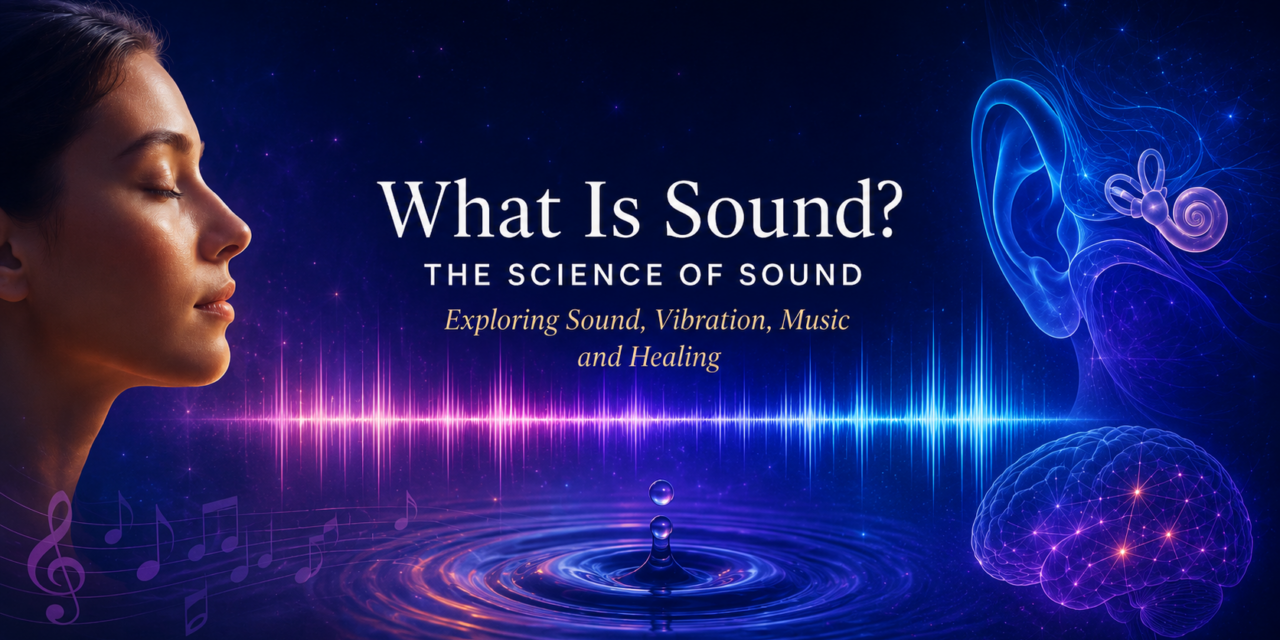
Sound is more than something we hear. It is vibration, energy and movement travelling through air, water or solid matter as waves. Every voice, instrument, bird song, rhythm and melody begins with vibration. In this article, we explore what sound is, how sound waves travel, how the human ear and brain process sound, and why music and healing sound can have such a powerful effect on mood, memory, relaxation and wellbeing.
Do you ever think about how sound is created or how it travels? How aware are you of the impact of different sounds on your mind and body?
The ability to hear and process sound is one of the most important functions of the human body.
Sound enriches our lives with excitement and meaning, especially when we interact with others, listen to our favourite music, or enjoy the beautiful sounds of nature. Each day, we encounter millions of different sounds just about everywhere we go.
It is up to us to decide how we will engage with these sounds and the quality we will choose to embrace.
The topic of sound is fascinating, so let’s explore it in greater detail.
Paul Darren Grout
Table of Contents
What is sound?
The three types of sound
How sound travels
The scientific characteristics of sound waves
How human ears receive and process sounds
How sounds influence us
Music and Mood Regulation
The Impact of Noise on Health
The therapeutic possibilities of sound healing
The Influence of Music on the Brain
Interesting facts about sounds
Educational videos on the topic of sound
Frequently Asked Questions – FAQs
What is Sound?
Sound is a type of energy made by vibrations.
In physics, sound is a vibration propagating as an acoustic wave through a transmission medium such as air, water, or solid.
So sound is a pressure wave caused by a vibrating object. The vibrations set particles in motion, and our ears pick up the pressure wave.
The particles transporting the energy of the wave, which is usually air, move parallel to the pressure wave. Sound is, therefore, a longitudinal wave.
Another way of describing this is that sound waves are generated when a molecule bounces into another molecule, which bounces into another molecule until the energetic waves reach your ear.
When we talk or sing, our vocal cords also vibrate, and the sounds are created. When a person hits a drum or the strings on a guitar, the molecules of these objects in motion vibrate.
The three types of sound
Sound waves are characterized into three diverse types.
- Audible sound waves are those that humans can hear.
- Infrasonic waves are those that are too low for humans.
- Ultrasonic sound waves are those that are too high frequency for humans to hear.
How Sound Travels
Sound is a series of waves that can travel long distances. It is produced by the vibration of the particles present in its medium. A medium is the material through which sound can travel such as air, water, or solids.
The human ears receive pressure waves which are turned into electrical signals by the auditory nerves of our brains where the vibrations are recognized as sound.
If you are within range of the vibrations, you’ll hear the sound/s.
The Scientific Characteristics of Sound Waves
The fundamental properties of sound waves are as follows. These properties intertwine to craft every sound we hear.
- Sound moves as a longitudinal wave. The wavelength of a sound wave shows the distance that the wave travels before it repeats itself.
- Loudness is determined by the amplitude of the wave.
- Frequency (the number of waves passing a point per second),
- Period. Time for one complete wave cycle to occur.
- The speed of sound is determined by the physical properties of the medium it travels through (such as air or water).
How human ears receive and process sounds
Sound waves flow through the outer ear and into the middle ear, where they force the eardrum and small bones to vibrate.
The middle ear transmits vibrations to the inner ear, which stimulates thousands of microscopic hair cells.
The small hair cells in our inner ear send electrical signals to the auditory nerve system, which is linked to the auditory region of the brain.
The auditory centre processes electrical impulses that the brain perceives as sound. Thus, the brain converts the impulses into sounds that we recognise and comprehend.
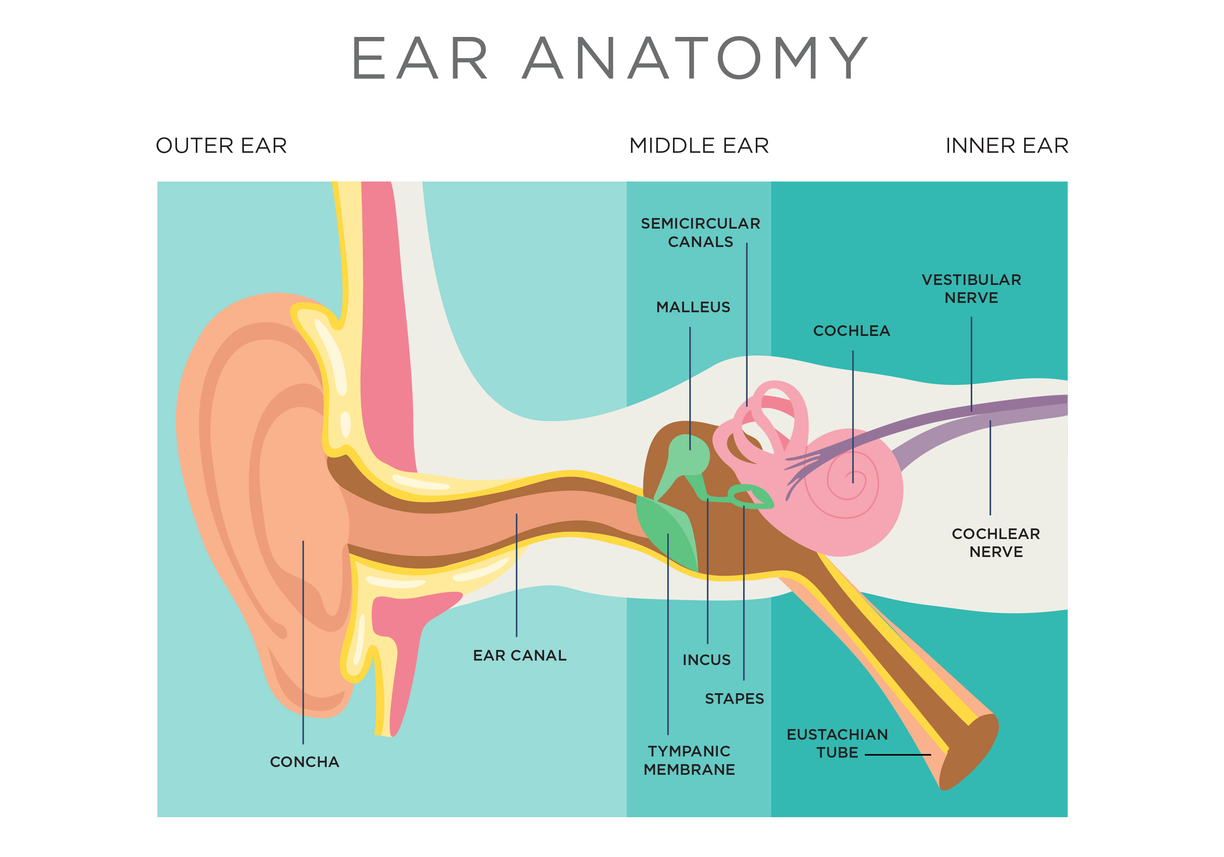
How sounds influence us?
Sound can elicit emotions, reactivate memories, and alter our physiological state.
When employed correctly, sound has the power to change our perceptions of the world and ourselves.
Sounds never have the same significant effect on our mental state as music.
Music may elicit some of the most powerful emotional reactions in people.
Listening to music affects brain regions related with memory, attention, and emotion.
Studies show that music and sound therapy can increase cognitive function, focus, and creativity.
Music and Mood Regulation
Music, whether it’s a catchy tune that elevates our spirits or a melancholy melody that speaks to our emotions, can significantly impact our mood and mental well-being. Music therapy is commonly used as a supplemental treatment for mood disorders,
Sound is more than a simple sensory experience. Its impacts extend beyond the auditory world, influencing our emotions, cognition, and physical health.
By utilising the power of sound and music in a variety of therapeutic and everyday settings, we can discover new dimensions of our human experience and improve our general well-being.
Sound and music are also often used in chakra-based meditation practices. You can learn more in my complete guide to chakra healing with music.
The impact of noise on health
When we are exposed to loud and unexpected noises, our stress reaction is triggered. This can cause the production of stress chemicals like adrenaline and cortisol, which can hurt our cardiovascular system.
Prolonged exposure to noise pollution has been related to an increased risk of hypertension, heart disease, and stroke.
Noise pollution might interfere with our sleep habits, causing sleep disruptions and insomnia.
When we are exposed to loud or continuous noise while sleeping, our sleep cycles might be interrupted, preventing us from falling into deep, restorative sleep. This can lead to daytime weariness, diminished cognitive function, and a lower overall quality of life.
For a practical example of calming sound in use, you may like this guided meditation for anxiety relief using music.
The therapeutic possibilities of sound and music healing.
Sound as a therapeutic method appears in most ancient cultures and faiths, and it is said to be the oldest type of healing.
Sound therapy is the application of various sound frequencies, instruments, and techniques to encourage relaxation, reduce stress, and improve mental health.
Sound and music therapy can help you move forward in your life and achieve long-term transformation by increasing the vibratory rate of your energy fields.
Sound and music may also be used as supportive tools for anxiety, low mood and emotional stress, especially alongside appropriate professional care where needed.
If you are interested in the therapeutic side of sound, you can also read my full guide to sound healing, which explores how vibration, intention and music may support emotional and energetic balance.
The Influence of Music on the Brain
Music and sound can boost brain processing capability and hemisphere synchronisation, improving learning and focus while promoting a more optimistic outlook for individual achievement.
Sound and music have a wide range of effects on how different parts of the brain work.
The brain’s four primary regions are the frontal, temporal, parietal, and occipital lobes.
When music enters the brain, all four sections function differently, causing different parts of the brain (within these primary areas) to become engaged and activated.
Due to its numerous constantly shifting components, including tempo, rhythm, melody, and tone, music is processed in the brain in a variety of intricate ways rather than following a single path.
Brain anatomy is a broad and intricate subject. To provide you with a fundamental understanding of how the brain processes sound and music, I have written an in-depth article about the healing effects of music on the brain, which you can read later by clicking here.
interesting facts about sounds
- Sound can help treat medical issues.
- Sound travels at a speed of around 767 mph.
- When sound travels through water, it moves about four times quicker than it does through air.
- A healthy young human ear can hear frequencies ranging from 20 to 20,000 hertz.
- Most animals utilise noises to detect dangers and hazards before they affect them.
- Water allows sound to move four times quicker than air because its particles are closer together.
- Whether it’s a symphony or a hard metal band playing at 120 decibels, both will harm your hearing.
- Unless it collides with something, the wind makes no sound.
- The incidence of hearing loss in classical musicians is reported to be 4 to 43%, whereas in rock artists it is 13 to 30%.
Educational videos on sound
Here’s a selection of films to help you understand more about sound waves and how they travel to the brain.
Frequently Asked Questions – FAQs
Is sound a form of energy?
Yes. Sound is a form of energy created by vibration. When an object vibrates, it moves particles in the surrounding medium, such as air or water, creating sound waves that can travel to the ear.
How does sound affect the brain?
Sound enters the ear as vibration and is converted into electrical signals that travel to the brain. The brain then interprets these signals as recognisable sounds, speech, music, rhythm or emotional tone.
Why can music affect emotions?
Music combines rhythm, melody, harmony, tempo and tone. These elements can influence mood, memory, attention and emotional response, which is why certain pieces of music can feel calming, uplifting, nostalgic or deeply moving.
What is the difference between sound healing and music therapy?
Sound healing is usually a holistic practice using tones, instruments, vibration and intention to support relaxation and energetic balance. Music therapy is a recognised therapeutic approach delivered by trained professionals in clinical or care settings.
Can sound help with relaxation?
Gentle sound, slow music, nature sounds and meditative tones may help create a calmer environment for relaxation. They can support breathing, focus and emotional settling, especially when used as part of meditation or rest.
Final Thoughts
Sound is one of the most powerful forces in human experience. It begins as vibration, travels as waves, and becomes meaning when the brain interprets it. Through sound, we communicate, remember, feel, relax, create and connect.
When sound becomes music, it can reach even deeper into our emotional world. A simple melody, rhythm or tone can change the atmosphere around us and the feeling within us. This is why sound is not only a scientific subject, but also a doorway into healing, meditation and self-awareness.
By understanding what sound is, we can begin to listen more consciously — not only to music, but also to the sounds of nature, silence, our own voice and the subtle rhythms of the body.
Continue Exploring
If you would like to go deeper into the healing power of sound and music, you may enjoy these related guides:
The Healing Effects of Music on the Brain
Sound Healing
Complete Guide to Chakra Healing with Music
Guided Meditation for Anxiety Relief Using Music
Social engagement
I welcome you to share your thoughts, feelings or questions in the comments area below. Have you noticed how certain sounds, songs or frequencies affect your mood or energy?
What I do as a Quantum Healing Musician.
Sound healing naturally assists your brain to steady its inner reactivity and so calm troublesome feelings of stress, anxiety, panic, frustration, hyper-alertness and distress.
As a Quantum Healing Musician, I create soothing piano compositions and meditations which aim to restore the natural healing frequencies of the mind and chakra energy centres to support a person’s life productiveness and wellbeing.
If you are not familiar with Chakras. These are energy centres or portals in the human energy field that receive and transmit energy and act as gates through which our life force flows in and out of our physical bodies. These energy fields can often become blocked because of physical, emotional, mental, traumas or spiritual disturbances. When Chakra’s become blocked we can often feel constricted or stuck in certain areas of our life. So Chakras require frequent rebalancing and recharging to function well.
I also identify the sounds and rhythms, which correspond to certain emotional responses and blockages and create pieces of music for the healing of all kinds of emotional and mental states. For example, I have created a series of music meditation videos (available on this website) to assist people to release emotional blockages, overcome stress and anxiety, empower self-love, forgiveness and create powerful intentions for personal success,
In addition, I create informative videos and articles on how music, rhythm and sound can be used as alternative therapeutic healing modalities.
To see examples of my work I welcome you to visit the website page Healing Music Videos & Articles.